Thursday, May 10, 2012

Copenhagen: Smørrebrød


I don't know about you but there are a few things that I will make for myself when I am home alone - and no one is watching. Things I would never make for a guest. Or even make for Ingo. I can't even call them meals - they are thrown together in no time, unsophisticated yet satisfying and somewhat guilty pleasures. Something like packaged ramen noodles dressed up with a healthy dousing of soy sauce or maybe that sweet and sour chicken sauce; basmati rice with maggi cube; a bowl of stove popped popcorn - thickly coated in melted butter and too much salt for most people's taste; spaghetti with nothing but truffle oil and salt.

They mostly require simple assembly and they often involve combining a small but specific number of little pieces. And that is why they remind me just a little bit of Smørrebrød - Danish open-faced sandwiches. The concept is simple: a single piece of bread topped with a couple of fresh harmonious ingredients like cheese and tomato, or salmon and onion. Something you might throw together if your were home alone for dinner.

But the Smørrebrød we had at Aamanns Kolonial Delikatesse in Copenhagen were definitely NOT your home alone variety. Behold:


In the "Jersey Beef" category: Tartare of jersey beef with egg-emulsion, tarragon, pickles, caper, onion and crispy potatoes. The combination of these simple but fresh, complimentary ingredients made this slice of bread a meal. Well, ok, maybe half a meal. Deconstructed tartar on a slice of dark bread with chips! All of those little pickled items, raw beef and tarragon swirling around in one bite! So delicious! 

There were several breads with fish, like "fried fish filets with green remoulade with tarragon and a lemon wedge" and "organic egg with fresh peeled shrimps, dill mayo, black pepper and cress". Decisions, decisions!


Or this, one of the fresh fish from Hanstholm and Iceland, a "sugarsalted salmon with cauliflowerpurée, pickled onions, endivesalad and crispy ryebreadwafer" as copied directly from the English translated menu.


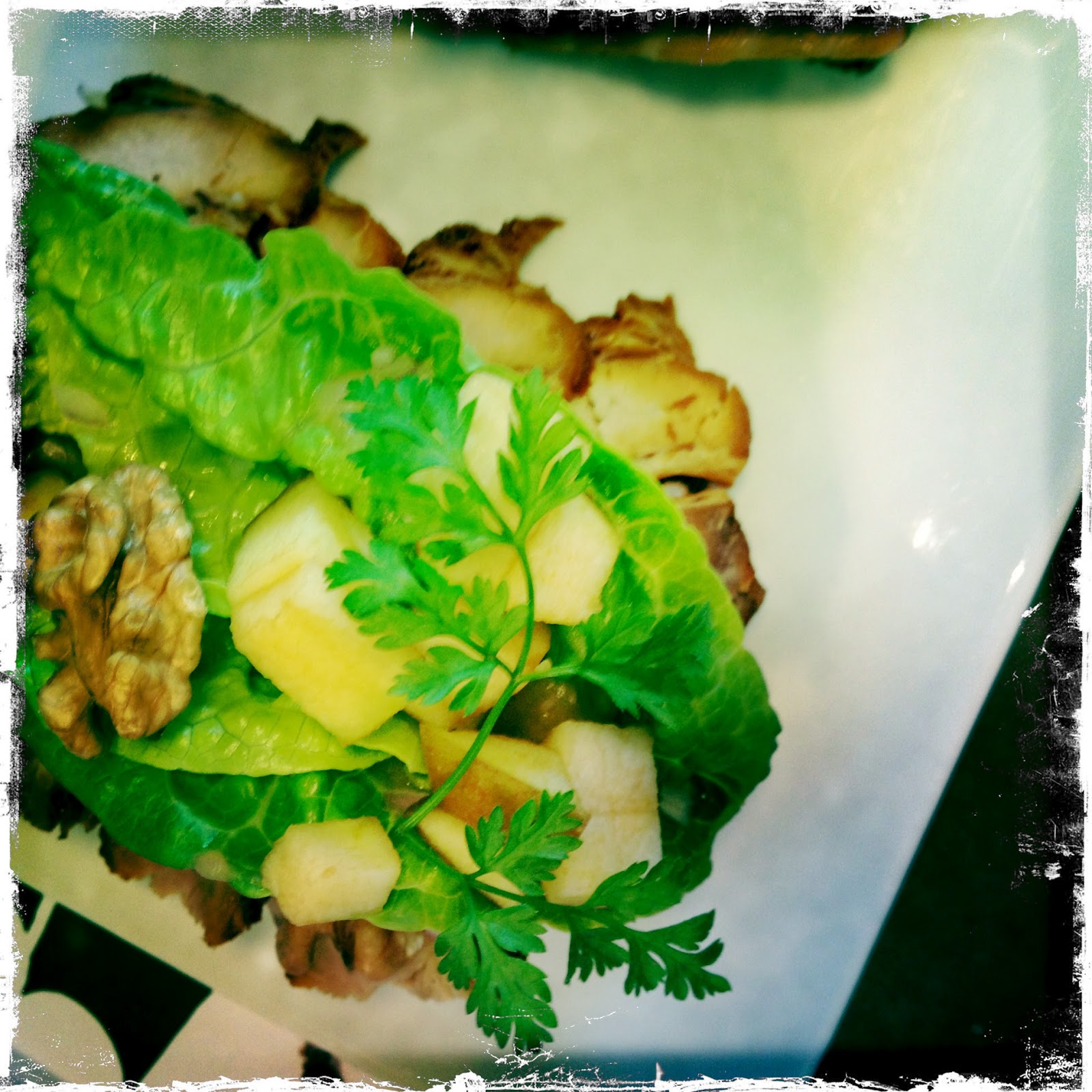
Or the "Freerange Pork from Grambogard: Pigs breast served with prunes, honey and applevinegar served with lettuce, fresh plums compote and walnuts". MMMMMMMMMMMMMMMM.

So simple in their complexity or complex in their simplicity. Yes, of course, Smørrebrød is Danish for "let's see what I have left over in the fridge and combine it all together on a single slice (for the carbohydrate-adverse) of dark bread!" It is the perfect home alone meal. Aaaaamazing Aamanns has definitely inspired me to see what kind of deliciousness I can come up with and fit on a slice of brød!


Friday, April 27, 2012

Copenhagen: The Danish Hot Dog


In northern Germany, there are a number of rivalries that define the region, polarize people and occasionally instigate all out wars of words. For example, the camp who insists currywurst comes from Berlin vs. those who believe it originated in Hamburg; the St. Pauli fans vs. the HSV fans; the born Hamburgers vs. the transplants; and those who insist Hamburg and all of northern Germany should still belong to Denmark (i.e. the Danish) vs. well, basically, Germans. It's a little dispute that the Fastaguchis love to jokingly (with the slightest hint of seriousness) get into, throwing historical jabs in favor of their respective countrymen, tallying battles and refusing to divvy the spoils. 

But one thing the northern Germans will admit, at least Kai and Ingo, is that when they do cross that border from Germany into Denmark, just outside of Flensburg, the first thing they think about is not territorial integrity, but hot dogs. Yep, pink, probably mechanically separated pork scraps wrapped in intestinal casing. These boys will pull over at the first gas station or rest stop and pony up the Kröners for (the first many) Danish hot dogs. 

So what gives, boys? You come from the land of sausage. Bratwursts of all shapes and sizes are available at every major sporting event, holiday market, street fair, etc. The entire Deutsch language constantly pays homage to its beloved pork products with sayings like, "Das ist mir wurst", meaning  "I don't care" but literally, "This is sausage to me"; or "Es ist sau kalt", meaning, "It is realllllly f*cking cold" but literally, "It is pig cold (or hot or expensive, insert other adjective)"; there are many others that I am forgetting (what is the one about "schinken" or ham? - German speakers chime in!) but the point is, pork is ingrained in the German psychy.


Despite the omnipresence of the wurst in Germany, these boys beeline for this: a "foot-long" skinny hot dog, in a one size fits all bun (that's not nearly long enough to accommodate the dog), topped with ketchup, mustard, raw onions, pickles slices and (the kicker that distinguishes it from an American ballpark hot dog) crunchy fried onions. And I must admit, either because it reminds me of my childhood or because it's somewhat "exotic" compared to the typical German wurst, I too, am a fan. 


We stopped at a little food truck downtown to kill a couple for lunch when the kids got whiny and tired. And they totally hit the spot. 

Monday, April 16, 2012

Copenhagen: Dinner at Mielcke & Hurtigkarl


So, after we run out of the house into a warm, waiting cab, we slam the door, give the cabbie directions and cackle as he peels away at how very clever/cunning and crafty/fabulous we must be to be heading out to dinner alone while the boys are home with the babies.

Mielcke & Hurtigkarl is housed in a gorgeous little greenhouse on the lawn of one of the Danish royal gardens. There is one open dining room with floor to ceiling windows, floral decal on the walls and a cascading chandelier that sprinkles light in droplets from above. The setting is formal but intimate, chic in an old school kind of way.

Rather than try to describe these dishes, I thought I would write a little haiku for each one. In full disclosure, this meal happened nearly two months ago and I cannot tell you as much as I would like to about each of these amazing little plates. And honestly, after wine pairings with every course, I am not sure I could fully describe each of them even an hour after we left the restaurant. What I can tell you is this: Fen's friend Jakob Mielcke, head chef and owner, is creative, attentive, and inspired. And while the food and perfect pairings played a prominent roll in the overall enjoyment of the evening, it was also just really, really lovely to be catching up with a good friend over a great meal. 

First plate from the chef
taste like a freshly mowed lawn
where unicorns play.

Potato on sand
eat the chips if you want but
they're decoration.

A shrimp with shrimp cream 
sit atop a cracker made 
of, surprise, more shrimp.

These small saffron eggs
cast a shadow on the plate,
looks like runny yolk.

The pebbles on sand
remind the chef of the coast;
these are potatoes.

 Looks like deviled eggs;
No, foie gras with raspberry;
Fen and I swooned.

Delicately rolled
leaves and ceps and greens in jus
of I forgot what.

I think this was squid?
It was a little slimy
yet delicious, too.

Roasted beet carpa-
cio looks a bit like roast beef
but it's not at all.

Jerusalem art-
ichokes never tasted as
good as they did here.

If I enjoyed the 
taste of lamb, I am sure I 
would have liked this more.

Smooth pumpkin ice cream
on thin ribbons of pumpkin
not too sweet, just right.

More drinks! Why not?! Beer
for dessert? Yes, of course! So 
sweet, frothy and good.

Sprinkled ferry dust
floated down from the ceiling
enchanted lighting.

Experiencing 
chocolate overload just
looking at this pic.

Foam! Foam! Ginger foam!
Carry you away on a 
cloud of bubbly schaum.

Fen, the evening was
fantastic. The food whoa and 
time with you priceless. 

xxx

Thursday, April 12, 2012

SmashandSniff Returns! And Copenhagen!

OH MY, it's been a long time. Sorry SmashandSniff friends, family, fans - there has been quite a lull here on the blog. But not a lull in real life. The last six months, for me personally, have included the birth of my third child, a breast infection that required hospitalization, 50 Thanksgiving guests - 15 of whom flew in from Paris, Prague, Copenhagen, the Hague, New York, London and Dubai, lots of family time over the holidays - including crashing with Smash and family in Chicago!, step throat, pink eye, a staff infection (and that was just me!), the wedding of a dear friend out in Jackson Hole, an Easter road trip to southern France and a quick and tasty weekend with friends in Copenhagen. Pfhhew. 

We could blame our absence on what Germans call "still dimens" or "breastfeeding dementia", but instead, we'll just apologize for deserting you so abruptly and get back to it. Sooooo, that said, why not start here...

If my friends, the „Fastaguchis“, had an emblem or an image to best symbolize their union, and that image were food porny, this might be it.

Two different yet equally adored pork products from Denmark, thick-sliced juicy bacon and thin-skinned pink hot dogs, on a Danish country plate adorned with … chopsticks. Kai, my half-German, half-Japanese, former Kabuli roommate, and his wife Fenja, my dear half-Danish, half-Norwegian friend have returned from Sudan and firmly ensconced themselves and their two gorgeous children in the Danish capital. No strangers to the chaos and challenges that small children and overnight guests breed, Kai and Fenja invited us up for a visit (actually, did we invite ourselves? We may well have..). A quick 4.5 hour train ride, an hour of which includes a choppy ferry crossing, and we arrived, all five of us, on their doorstep.

As a couple with children, you quickly learn to hone your bartering skills. “I’ll trade you a Wednesday night out with Martin to watch the Bayern-Dortmund game for my Friday afternoon hair appointment.” And sometimes, when you’ve sharpened those skills enough, you may be able to slant  things slightly in your favor. Like the Friday night we arrived in Copenhagen. Kai and Ingo got five hungry, tired kids under four years of age at bedtime in the guise of quality time together while Fen and I got our five hours of QT with ten courses – including wine pairings – at Fen’s friend Jakob’s restaurant, Mielcke & Hurtigkarl. Luckily we were in the cab on our way to the restaurant before the boys realized that negotiations may have resulted in a lopsided trade. Or at least before they could object.

Jakob's creations were so gorgeous and our evening so lovely, it deserves it's own post. Forthcoming - tomorrow...

Wednesday, November 9, 2011

Ten Days in Puglia, Part 3: The Heel of the Boot


This was the first time I had booked a vacation home online, sight-unseen. I was a little wary as photographs online or in brochures occasionally accentuate the positive to the point of distortion. But I was also quite intrigued. When I contacted Bruno, the owner of “La Grica” where we stayed just outside of Tricase in southern Puglia, via the HomeAwayUK website, he sent me a link (www.lagritca.it) providing additional information on the location and amenities.

Upon arrival we thought, perfect! This is exactly what we expected based on the photos on the website! The house had whitewashed walls, blue shutters and painted tiles, a thatched roof protecting the large terrace surrounded by olive and fig trees. It reminded me of postcards from Santorini and had the same view to boot – an unobstructed 180 degree panorama of the Adriatic sprawled out before it. I typed “sea view” into my house hunt criteria on the HomeAway site and sea view is precisely what we got.


The inside was basic but sufficient and clean. The terrace was really so amazing that we didn’t spend much time inside. There was even an outdoor shower and a clay pizza oven and grill.


The beach was not right out the front door but was accessible. Being on the Adriatic side of the “heel”, we were on the rockier, untamed side. There were steep winding staircases carved into the rockface every few kilometers where swimmers can make their way down to the intensely turquoise water below. For divers or snorkelers, it is a dream; for parents with young children, it’s a bit of a nightmare. The pathways were steep in places and windy conditions meant strong waves which made getting in and out of the water tricky. Kids would do better on the sandier shores of the Ionian side between Santa Maria di Leuca and Gallipoli.


Speaking of kids, if we were to bring the kids back with us next time, I unfortunately would have to say that we probably would not choose to stay here again – as much as I would LOVE to. The house is located just off of a busy road (although you don’t notice this because the house itself is situated down a windy set of stairs, far below) and while the terrace was perfect for my husband and myself, it would be a bit limited for a few small children who would want to run around and kick balls – all of which would fly over the railing and roll 100 meters through olive groves toward the sea below. Easy beach access or a nice yard would be much more ideal for children. Basically, its not the kind of place you as a parent could relax and let the kids run around unsupervised: steep steps, busy roads, vertical drops – it’s the kind of place where you would want to have your kid on a dog leash. But for 2-4 adults – it is an absolute dream. If we can cajole the grandparents into taking the kids again, we would love to get a couple of friends together and come back here.


Or more. The house has two parts; the lower part was rented out to another couple, a middle aged Italian couple from Rome. We said hello in the mornings and they shared a few restaurant tips with us but otherwise, we were very respectful of each other’s space and we rarely noticed someone else was there.


Bruno rented the house on a weekly basis, from Saturday – Saturday. We explained to him that we would have to leave Thursday, two days early, as we had stashed the kids away with their grandparents and need to get back and he gave us a 100€ discount on the weekly rate – which was incredibly nice of him, as he didn’t have to do that.


Speaking of Bruno, he had the keys waiting in the door for us when we arrived. He came up shortly thereafter to introduce himself, see if we had any questions and clue us in as to where to find groceries, the nearest gas station, and the best restaurant in the area. His house was situated about 100 meters below ours and he instructed us to come see him if we had any questions or problems.


About Puglia itself...


Puglia is best undertaken with a car. Public transport is limited and bicycles require serious quadriceps for the gorgeous cliff-hugging roads. Small, charming towns like Otranto, Gallipoli, Santa Maria di Leuca on the coast offer incredible seafood, nighttime passegiatas that take one back in time through the old winding streets of the walled cities, and soft sandy beaches with turquoise water that locals liken to the Maldives. Small villages on the interior like Specchia, Taviano, and Tricase provide a peek at everyday life on the Salento where visitors can stock up on local produce from nearby farms (Puglia is famous for its vegetable antipasti), homemade salami and cured meats and legendary fresh cheeses like Puglian burrata. At A Casa Tu Martinu, diners (like us) sit al fresco in a gorgeous courtyard garden sampling the bread dipped in vino cotto, a cooked wine sauce, bruschetta melanzane, discs of fried eggplant a top a pomodorini salsa, fresh handmade orrchiette with stewed greens or pasta all ceci, pasta with chickpeas. Fresh produce is also the star on the menu at the many messerie in the area. Messerie are former or current farming estates that boast some of the freshest fare in the Salento.


We usually spent the mornings gasping at the view from our terrace over thick slices of succulent watermelon and strong shots of espresso. By the time we managed to tear ourselves away, it was nearly noon and we would explore one of the nearby towns while everyone was at home having lunch, avoiding the mid-day heat. We would escape the heat at one of the gorgeous beaches – Baia dei Turquie north of Otranto or Baia Verde, otherwise known as the Italian Maldives, south of Gallipoli – from 3 pm onwards. One afternoon, we opted to rent a boat and explored the gorgeous rocky coastline around the Baia dei Zagare, south of Otranto and the cliffs and coves north of Leuca.


Gorgeous beaches, delicious fresh fish and vegetables, stunning views and a very relaxed local vibe is what we experienced in the Salento. Thanks again HomeAwayUK for the opportunity to stay in one of your amazing properties. We will definitely be staying with you again soon!

Friday, August 12, 2011

Ten Days in Puglia, Part 2: A Basilicata Seque and Southward

Lovely, limestoney, Trani welcomed us into a gorgeous old monestary and fed us fresh fish and creamy gelato.
Had we been staying in an apartment instead of a hotel, we would have hit up this charming fisherman and his selection of langoustine, pulpo, sea urchins and fresh fish.

Sometimes you just stop, right there in the middle of the street, and admire. But keep an ear out for oncoming Vespas. They'll sneak up on you, fast.


In case you've thought about doing one of those "Leaning Tower of Pisa" poses on other monuments, you might want to reconsider, as Ingo cheerfully demonstrates at the Castel del Monte, about an hour outside of Trani and high on Ingo's, "Must see before I die" list.


So, Matera. In all honesty, I had never heard about Matera until I read this article. I am not sure if the city, particularly the former cave dwellings, referred to as the "Sassi" or stones, have attracted many tourists in the past or if the industry got a boost when Mel Gibson' filmed "The Passion of the Christ" here in 2004. But it appears that Matera is poised to become a sort of Disneyland for spelunking tourists. Declared a UNESCO World Heritage Site in 1993, the old cave dwelling side of the city faces a gorgeous arid canyon. The caves were actually inhabited until the 1950s when the Italian government forced residents out because it was an "embarrassment" to have people living in such squalor in modern times. Government high rises were constructed and the former owners were begrudgingly relocated. Begrudgingly because these caves were kinda rad. They stayed cool in hot summers, boasted the first irrigation system in the city and offered membership into a sort of tight knit community that comes from living literally on top of each other.

We booked a room at the Sextantio Albergo Diffuso Le Grotte della Civita which coincidentally, is the primary focus of an article in the upcoming September issue of National Geographic Traveler Magazine entitled "The Towns Italy Forgot". (Another one of those DAMNIT!! WHY DIDN’T I WRITE THIS!! moments). As Miriam Murphy says in the article, it is a one-of-a-kind hotel and she speaks with the proprietors and provides interesting background on the architect’s vision for the hotel and other similar projects focused on resurrecting abandoned villages while preserving their architectual and historic integrity. And although Phillipe Starcke obviously wasn't around back in the day to design bathtubs for the cave dwellings like the one in our hotel room, they do use mostly locally sourced materials, like the dark woods used by local carpenters to make the closets and tables. Or old stone troughs used as sinks.

We wandered the city from one steep slippery stone walkway to the next. Which was a bit of a technical feat being that I was 6 months pregnant – meaning I had to haul around 20 extra pounds and my balance was off - and it was 95 degrees. But the views kept us going, every winding trail offered scenery more spectacular than the next. As much as “jaw-dropping” is an overused cliché, I can’t think of a better word to describe the Sassi.

In a country like Italy, there is very little left to “discover” – the famous works of art and architecture have all been found, documented, restored and displayed. The charming fishing villages have traded in shanties for boutique hotels and waterfront seafood restaurants, the best beaches are covered with “bagni” where it costs 20 euro a day to have the privilege of sitting under one of their umbrellas and on one of their beach chairs, the best restaurants have lines and waiting lists, as do the most significant cathedrals and now even the wild countryside of Tuscany and Umbria boast views that are blocked by sign after sign for the newest oldest agrotourismo accommodations and dining.

 
Our cave room
Don’t get me wrong, I love Italy. I fell madly deeply hopelessly in love with Italy when I was 16 and went abroad for the first time in my life on a Rotary exchange program. I spent the summer with two families, both of whom had a girl my age who I quickly called my best friend and both of who lived outside of Milan. I was enchanted by the animated language from the lyricism of the words that would be impossible to speak in a straight jacket for lack of use of the hands and entire body. I was thrilled that dinner started with a huge plate of pasta – just started! I looked forward to the afternoon lull following lunch where we’d lay around and watch bad talk shows or just talk. But most of all, I fell head over heels for Massimiliano. And let’s be honest, a short but sweet love affair will definitely taint your view of a place.

 
The common room
Massimiliano is long gone but my love for Italy remains deep. The way they stock legs of prosciutto and wheels of Grana in gas stations (!) and convenience stores (!), the repertoire of endearing names you are called by complete strangers and acquaintances (Ciao bella! Ciao stella! Ciao gioia!), the stand-up espresso counters and potato chip buffet apperitivi, the nonnas in their one-size-fits-all moomoo dresses and knee high stockings, the way the women will get made up, decked out, dressed up just to go out to the corner store for milk, the multitude of hand gestures that one must learn to actually understand the language, the tolerance for sexist talk shows that have not changed in 20 years. Even the annoying things – especially the annoying things – are endearing. That’s love.


And the touristy stuff is often endearing as well. But not always. If Italy had a Masai Mara, a Chang Mai hill people tour, an overtouristy, voyeuristic, over-hyped, something potentially interesting relegated to the ranks of banal, it would be Alberobello and “trulli” country. Please tell me I am wrong, I so wanted to be enchanted. And I preface my opinion by saying we had only 24 hours to spend in the Valle d’Istria – nowhere near enough time to explore it properly. I would have loved to spend a week in an artfully restored trullo somewhere in the countryside – and I don’t doubt there are many of them and that they are amazing. But I am atalking about Alberobello.

 
A typical trullo in Alberobello

Just skip it. Drive by. Snap a pic if you want. But don’t stay there. It’s the kind of place where you feel like you got suckered. You will be angry with yourself for falling prey to the trulli scam. At least, that is kinda how we felt. Go instead to Locotarondo for dinner, and stop in Martina Franca for granita at the M Betitto Sorbeteria.

An evening stroll through Martina Franca

Drive by the trullis in the fields, maybe stop by. But do yourself a favor and skip Alberobello. Maybe it’s because we just came from Matera, or maybe it was the family from Long Island who was walking around behind us with a heavily accented running commentary, but the town was just – meh. Everyone wants to sell you something, or provide you with an “authentic” stay in one of their trullis. Just avoid. Overall we were surprised by how “untouristy” Puglia is. At least, by foreigners. Italians discovered Puglia long ago and continue to appreciate its beaches, its food, its towns. But the rest of the world has only just started to catch on. And a great way to take it all in, is to set up shop there for a little while. Like we did. With our HomeAwayUK rental on the Adriatic coast just outside of Tricase, north of the southern most tip, Santa Maria de Leuca. Next and final installment: our amazing little house on a cliff and the southern tip.